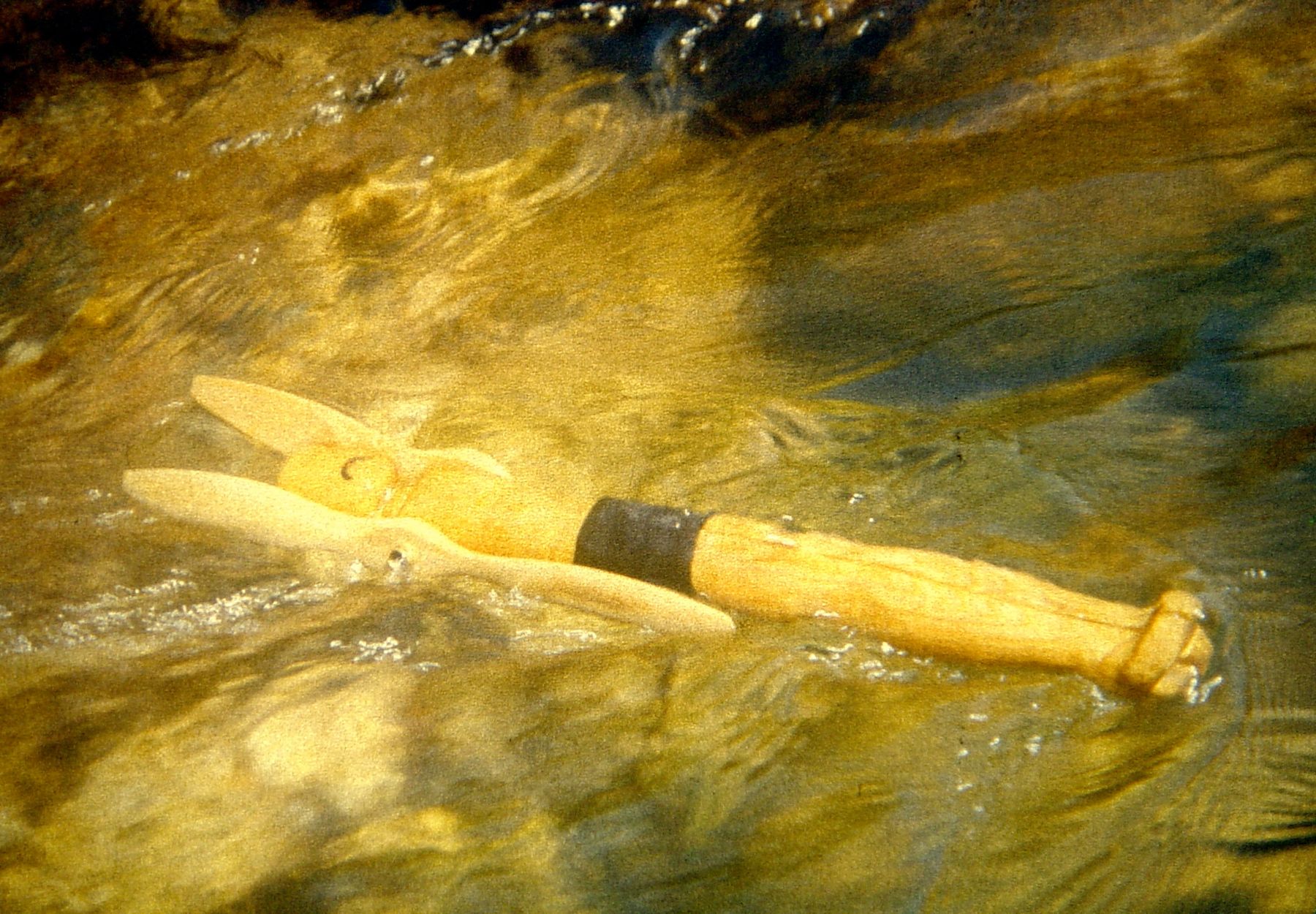
“Adventures with Billy He's the only human being in recorded history to claim the distinction of swimming the entire length of the Mississippi River. He was buried alive for three days in a much-ballyhooed effort to bring art to the spirit world that included a New Orleans-style funeral complete with Christlike resurrection. He once publicly imprisoned himself in a tiger cage to protest the inhumane treatment of POW's in Vietnam. Maverick/ Eccentric? Full-blown madman? Billy X. Curmano will be delighted to let you decide. For the past 27 years the Minnesota-based performance artist/environmental activist - who earned an M.S. in sculpture from the University of Wisconsin and has had exhibits and installations in the U.S., Japan, Spain and Austria - has been a fixture in the public consciousness of the Midwest (journalists have described him as 'the court jester of Southeastern Minnesota') and has earned praise around the world for his creative vision and politically directed artistic consciousness. 'I don't consider myself an extremist,' the bushy-headed, mustachioed Curmano mused during a TV interview. 'Actually, I'm a conservative living in extreme times.' This weekend Curmano ventures forth from his farmhouse in Rushford, Minnesota, base of operations for his Experimental Artwork Terminal #1, to make a rare live appearance in L.A. His show, entitled 'Adventures with Billy', is an obstreperous blend of monologue, video, slide projection and live music chronicling his most famous achievements. Among these are his swim of the entire 2,500 miles of the Mississippi, from Lake Itasca, Minnesota to the Gulf of Mexico, a ten-year-long performance piece/activist statement designed to inspire people towards awareness and respect for 'water, the source of life'; his self-imposed interment, where he spent three Houdini-esque days in a coffin six feet under (cheating a bit with full life-support systems on hand); and his delightful 'Cow-a-Bongo: Bongo Bovine', in which Curmano and his band staged a jazz/pop performance for a herd of bewildered cows in the wilds of rural Minnesota, witnessed by an equally bewildered audience aboard a tour bus to the site. Curmano calls 'Adventures with Billy' 'a slightly satirical journey documenting art as life and life as art.' I call it an uninhibited blend of courage, charisma and chutzpah, the sort of thing you either love or hate but definately aren't allowed to regard with, God forbid, neutrality." - Mary Beth Crain, "LA WEEKLY", Vol. 21 #12, Feb. 12-18, 1999, Los Angeles, CA.” - Mary Beth Crain
— LA WEEKLY
“The Documents Left Behind from Live Performances An exhibition explores how the remains of performance art memorialize the past and re-perform for new audiences. Enacting the Text: Performing with Words, currently on view at the Center for Book Arts, uses performance art’s detritus as its starting point. Curated by Nicolás Dumit Estévez Raful, the exhibition explores the ways these remains memorialize the past and re-perform for new audiences who may never have seen the original performance. The exhibition space is small and intimate, squeezed between workshop areas; the glass cases of materials create rows down the center of the single room, while larger posters and prints line the outer walls. The sheer time required to read all the invitations, notes, sketches, and scripts, flip open the books (yes, you can touch the books!), and watch all the video documentation, is vast. The viewer re-performs the texts, imagining the scenarios and activating the yellowing letters, while also participating in the very performance of art viewing, as people queue up behind lengthier texts and watch others read. Beatrice Glow’s artist book Taparaco Myth (2009), displayed here, details her trip through Peru, following the Chinese migrant labor movement there. For a series of artist talks accompanying the exhibition, she traced the use of the word “Chino/a” and the people it’s used to describe throughout Latin America. Glow’s journey is both a physical and linguistic one, exploring the racial politics of naming colors, places, and people. Beginning with the racialized coloring naming system of Pantone, she flipped through images on a projector at varying speeds, switching between languages — English and Spanish — as she guided the audience through her voyage. Showing existing photographs, maps, color swatches, birds, and various signage across Latin America featuring the word “Chino,” her sarcastic and humorous presentation became a satire about racism and migration. The most animated performance perhaps came from Martha Wilson, who, dressed in a suit and a bright orange wig, performed speeches, shouting and singing as “Donald Thump,” complete with hail salutes scattered throughout. Towards the middle of the performance, she broke character, putting on glasses to discuss her experience performing as various political figures and to outline what she saw as the relationship between art and politics, particularly during the culture wars, where government funding attempted to censor artwork that served as a voice for minorities. The scripts for Wilson’s “Just say No to Arms Control” (1987) and “Nancy Regen Beats Cancer” (1985), along with the lists of props used, document her performances of these speeches. The artist’s typewritten pages, covered in handwritten notes and edits are lined up in another case. Another script presented behind glass is Linda Mary Montano’s Mitchell’s Death, handwritten with notes, along with a video of its performance, allowing the viewer to experience both the documentation and a version of the intended viewing. The majority of the texts and videos on view are more documents than vestiges of past events, with the exception of a few items that were part of the performance, such as a scattering of Lesley Dill’s flyers and brochures, which are both recordings and parts of her performances. The brochure Tongues on Fire: Visions & Ecstasy (2000–2001), pinned open in a case, collects the stories of people’s dreams recounted to Dill. But, as the scripts begin to suggest, there is no clear line between documenting object, prop, and art object. Further evidence of this lies in a section of one wall, covered with defaced images of artist Billy X. Curmano, as part of the “Deface Billy Project.” These flyers, which look like coloring book pages with the artist’s face, were distributed with instructions to be colored on. Thus these objects are both documentation, prop, and performance art objects. But performance art is not precious. Leaving few remains, save the type of objects I’ve noted, the pieces that endure are more archive than art, as far as these distinctions are useful. Enacting the Text is not the first exhibition to challenge the distinction between art and archive, but it smartly uses performance art ephemera to further question these boundaries, specifically with regard to the role of the document. Sketches and notes that precede a painting, for instance, are more easily categorized as “archive,” since the “art” is the finished painting; but when no completed work is left, the role of documents becomes more slippery. Though our reading of Glow’s artist book or Wilson’s scripts does not recreate the original performances, by reading the text we are given the agency of the artist, to interpret and enact the artwork ourselves. Rather than a static fixed history, the document is a living, malleable, continual performance, at once an archive and artwork. Enacting the Text: Performing with Words continues at the Center for Book Arts (28 W 27th St #3, Chelsea, Manhattan) through December 17.” - Megan N. Liberty
“Bringing an Eco-Art Tributary into the Media Mainstream by Swimming the Mississippi A great majority of conservation biologists agree that we are in the initial stages of a sixth megaextinction. Unlike previous "catastrophic" extinctions attributed to various geological, astronomical, and climatological causes, this one is human-induced. How can we translate such abstract knowledge into embodied action? Witnessing the vulnerability of another's fragile flesh evokes a visceral identification--a sobering reminder that we are all at risk. Billy Curmano, intermedia artist, musician, activist, and Vietnam veteran, literally swims through our collective sewage to wake us up. Traversing the Mississippi from its source to the Gulf of Mexico concluding on July 23, 1997, Curmano brings attention to the promises and perils of this "Father of Waters." In his award-winning documentary video, he engages those who live and work along the river - taking periodic breaks to converse with a fisherman or stage a performance along the shore. In reflecting on his work, while floating downstream, Billy asserts, "Artists often paint their fantasies; I try to live mine." Curmano asks nothing less of his students. He opens his workshops and residencies with a performance, inviting his students to engage their bodies and senses. In his CAA ECOtistical workshop, he performed on a Vietnamese ocean harp and mingled the waters of the Mississippi and Atlanta's Chattahoochee River. He then discussed some of his students' projects. At University of North Carolina, Curmano's Chapel Hill students put their sculptures on the line, siting them outside the Hanes Art Center, a common exhibition area for art students. Knowing that there was a history of art vandalism on the campus, members of the eXperimental Art Research Team (XARTCH) staged a "clandestine art operation." Between March and April 1995, XARTCH trained hidden video cameras on 11 sculptures over a period of three weeks between 10pm and 3am. Though they were not surprised that the work was broken or stolen, they were unprepared and angered by the extent of the damage caused to five of the pieces. True to Billy's own strategy of placing his body in harm's way, his students confronted the vandals and gave them the choice of either a public forum in which they could answer to the students or face criminal charges (vandalizing university artwork valued at over fifty dollars is a Class H felony). The process of confrontation and dialog not only educated the broader campus community, but the event gained wide media attention, with articles in two local papers and a news brief in the New Art Examiner. The students created a social sculpture in which their collective works became a catalyst to rectify a problem endemic on university campuses. The students learned how to turn their anger into an opportunity for public education through direct action, civic engagement, and savvy media strategies. Many artists use blatant confrontation to goad the public into recognizing their social complicity and responsibility. Such strategies can be highly effective but they can also backfire, resulting in resentment and little insight. What distinguishes Curmano's work and pedagogy is its intent to educate and enlighten - it is eco-tistical, not egotistical. When confrontation is embodied in a social desire to transform rather than taunt, to teach rather than manipulate, it can become a potent device in a young artists' toolbox for transforming communities and landscapes. - Ann Rosenthal, Billy X. Curmano- Bringing an Eco-Art Tributary into the Media Mainstream by Swimming the Mississippi (NYC, NY: CAA, Art Journal, Vol. 6, no.1, Spring 2006), 67.” - Ann Rosenthal
— Art Journal
“The Sacrificial Aesthetic: Blood Rituals from Art to Murder The artist becomes or enacts the sacrifice, the stage represents sacred space, the performance is held in sacred time, and significantly the blood is fresh, crimson and free flowing. A classic example of performance art as blood sacrifice is a performance entitled "Bloodbath" by Minnesota Artist Billy Curmano. Press releases announced that "The artist’s own blood is shed in a human sacrifice intended to focus attention on global violence."(16) At the performance, which was symbolically held on Saint Valentine’s Day, Curmano was dressed in white and sitting next to a globe of the world; the audience was informed that his blood would be spilled as a sacrifice to ease the need for suffering and death."(17) Since Curmano had promised that he would supply his own blood for the sacrifice and would not mutilate himself on stage, a nurse sat next to him and extracted a dozen vials of blood by needle from Curmano’s arms as a drum beat in the background. During the ceremony Curmano opened each vial with his teeth and spilled his blood on the globe while a voice offstage announced the names of countries in conflict. (18) Although this encompasses all aspects of the use of blood in sacrifice, it is basically a non-violent performance.” - Dawn Perlmutter
— Anthropoetics (UCLA) and EuroArt (WebMag)
“Midnight Babylon In 'Midnight Babylon" the audience looked on as the artist - awakened by a nightmare - spent a sleepless night recalling nightmares and ruminating on the horrors and humor of war, life and television. The work was performed on the first evening of a three-day teach-in on U.S. policy in Central America. Billy Curmano shared the bill with singer/songwriter Country Joe McDonald. Because of the context the audience was not a typical one for a performance piece. However, the attentiveness, laughter and several interruptions of the performance by enthusiastic applause were proof that Curmano's writing and energetic performance were reaching everybody. A vertical bed, a stool and a projection screen provided a stark setting that focused attention on Curmano, while reminding us that we were eavesdropping on an insomniacs monolog. Awakened by a nightmare and then frightened by a clothe-tree, Curmano recalled a nightmare containing both ridiculous and frightening symbolic images of war. The lights faded and then returned to show Curmano sitting on a stool staring at his left wrist, his left hand bent back. A razor blade in his right hand remained poised in the air - almost forgotten - as he spoke of the pleasure of watching his pulse beat, feeling the blood flow through his body. Then he agonized over the frustrations of life and society, sometimes wanting to blow the whole thing up. But, like blood circulating, his soliloquy came full circle when he concluded, 'It don't mean nothing. It don't mean nothing at all.' He described a television awards show, 'The Wammy Awards', for the top ten current wars. The description was interrupted for a word from the sponsor, Art Works USA, Curmano's studio in Rushford, Minnesota. Slides, music and recorded narration advertised three of his wearable sculptures: a pair of boots on small rockets, a vest adorned with sticks of 'dynamite' wired together and a strap-on pair of legs in the full-lotus posture. Returning to the awards show Curmano became the master of ceremonies, joyfully announcing the death-count and a brief history of the top ten current wars. Religious fanatacism - of both the right and left - were credited for the honors. The Iran-Iraq War, with a half-million dead, was the winner. Curmano became the grateful recipient of the prize; his thanks included appreciation to the Reagan Administration for helping both sides accomplish the slaughter. Suddenly Curmano realized the night was over. We were delivered from one surreal world to another: 'I gotta go. I gotta get to work. I'm almost late." - Reggie McCleod, "High Performance", Astro Artz, Los Angeles, Issue 38, 1987.” - Reggie McLeod
— High Performance
“The Renegade: Pranks, Performance and Billy X. Curmano's Idea of Fun Profile by Matt Konrad January 28, 2008 Maverick Winona-based performance artist Billy X. Curmano chats with Matt Konrad about the artistic impulse that has driven a long career of daredevil feats, political chutzpah, and making art his own damn way. BILLY X. CURMANO, PERFORMANCE ARTIST AND PROVOCATEUR, doesn't really care much for conventional wisdom. Take the stereotype that art is the province of dour, black-turtlenecked urbanites. Take it, and then kick it as far away from Billy as you can. He grew up in Milwaukee and spent time in the East Village, but, ultimately, he decided to make his base of operations a picturesque corner of Southeastern Minnesota. From there, he plans extravagant performance pieces, publishes wry, pun-filled newsletters, and toys with questions right down to the “what the hell is art, anyway” level. Billy’s work challenges the idea that grand adventure is the exclusive right of those who can afford it. Bored billionaires might be traveling around the world in balloons and paying to be towed up Mount Everest, but they’ve got nothing on Billy Curmano. He decided it’d be an eye-opening performance project to swim the Mississippi River from Lake Itasca to New Orleans—and then, over eleven summers, he did just that, landing in the Big Easy on Billy X. Curmano Day, 1997, thus culminating Swimmin’ the River his best-known and grandest-scale performance. Though you might not guess it from his ready smile and the graying mustache, Billy Curmano is a rebel through-and-through, doing his own damn thing and creating performance art, music, sculpture, and an artistic atmosphere that’s impossible to ignore. “I just like to do work that is interesting,” Billy says on the phone. When we talk, he’s in the midst of a massive move from his studio space in Rushford, which suffered extensive damage during the Winona-area floods last summer. “I like the idea of getting out to different audiences and doing work that intrigues them, whether they understand it as art or not. I like tweaking them,” he explains. “I think about it the way I think about homosexuality—if someone’s secure in their sexuality then they aren’t homophobic. I feel secure enough about my work that I like to get a response from the audience, but if it’s not the right response, I don’t mind. You just have to please yourself. If you’re doing work just to please other people, you’re not getting at the root of your soul as an artist.” An overview of Billy’s career indicates that, for all of his wide-ranging work, he has indeed stayed true to his roots. He trained as a sculptor at the University of Wisconsin-Milwaukee, and returned from a stint in Vietnam as a full-time artistic rabble-rouser. In time, he added music and guerrilla street theater to his repertoire. The twin poles of his work have always been to raise perceptions and to have a little fun. These aims are evident throughout his oeuvre, from his early anti-war installations at UWM to a "performance fast" in the Mojave during the Y2K freakout, and in his Buried Alive project, in which he spent three days entombed near Winona in an effort to bring art to the dead. And most of all, this commitment to serious-minded fun is apparent in his signature Swimmin’ the River project, which managed to make an environmentalist statement, an individualist argument, and a decade of entertaining summers all at once. “The Coast Guard came after me just past St. Louis,” he recalls, thinking about one of the most intense days of the swim. “It was a really tough run through a major shipping center, about 100 miles with coastline and barges. When we were going away from [a welcome ceremony at] the Arch, this Coast Guard boat came up behind us. I yelled at them ‘I’m okay, fellas, thanks for checking.’ Through the megaphones, they yelled back. ‘It doesn’t work like that.’” As is his wont, though, Billy kept on swimming. His crew in the support boat enlightened the Coast Guard on the project, eventually making even them believers. (Billy was a bit disappointed that he didn’t get to argue in court about people having the same rights as, say, shipping barges, but that didn’t dampen the spirit of the run one bit.) The Mississippi River swim is also exemplary of Billy’s dedication to true multimedia pieces. The work encompasses more than a one-time performance. These days, he still frequently exhibits his self-produced documentary about the event, taking a break to perform songs including “River Rap;” and in conjunction with all this, he shows a variety of mixed media sculptures he created to record the event. In fact, some of his work still includes the Mississippi itself: he’s used water collected from the river in subsequent pieces, in one case mixing a commemorative vial of Big Muddy with the Arctic Ocean (whose shores were reached, in true Billy fashion, via public transportation). With Billy’s tendency to mix the ephemeral with the lasting in his work, he has, in effect, built a well-traveled bridge between performance art and visual art. He’s building similar bridges in other areas, too. The floods in the Winona area forced him into a new studio home (which, as it turns out, also had some water problems—he wryly notes that FEMA offered him a dehumidifier to help with the move). He’s now building it into a complex that will include a personal studio, a home for his New X Art Ensemble, a rotating cast of musicians, and an alternative-to-the-city performance space and gallery. The Ensemble performs frequently both at home and in the Twin Cities, and Curmano is also working on other projects like an annual “Anti-Shakespeare Festival” to run in conjunction with Winona’s Shakespeare Festival; the first, two years ago, ended with Curmano having to canoe around an island looking for campers that had spent the night. And he continues to shoot videos, craft sculptures, and design sets for his performance work. Overall, his tendency to mix the ephemeral with the lasting allows him to shifty freely between performance and visual art. For a guy who couldn't give a damn about “rules” in the art world, his underlying aim is a serious one. He’s dedicated, through his work, to leaving something of himself behind. “I began working as … the term ‘traditional artist’ doesn’t really apply, but I made objects,” Billy recalls, thinking about how far he’s come as an artist. “The sculpture department at my college didn’t take real kindly to performance art. It wasn’t heavy enough. But one professor I had, he once told me, ‘Billy, we were always proud of you, because you didn’t lose sight of the object.’ And I haven’t.” About the writer: Matt Konrad lives in Minneapolis, where he writes about everything from soccer to cocktails. His work appears frequently in Metro, and you can visit him online at The Cash Box and the Taste Mafia. When possible, he chooses to do his river trips via canoe.” - Matt Konrad
“Threat Level 3 Orange Alert Neither the name of the band nor the album connotes any danger from Homeland Security. Instead, Threat level 3 turns their Orange Alert into electro-acoustic free jazz meditations on world music. Ex-Milwaukeeans Billy X. Curmano and John Pendergast pluck, strum and bow their stringed instruments as Minnesota Steve Smith blows tenor sax and didgeridoo. The inclusion of ocean harp and Zimbabwean Mbira and trippy electric dulcimer makes for textures harsh enough for intentional listening yet unobtrusive enough for background ambience or avant-garde soundtracks. One piece accompanied by a spoken-word love poem of ambiguous sincerity makes for a dry-humor hoot. Even more engaging, however, are the rickety samba grooves appearing on a couple of pieces. This album is not for smooth-fusion fans by a long stretch, but for those with ears to hear, Threat Level 3 make advanced music theory and dissonance fun.” - Jamie Lee Rake
Hyperallergic Megan N. Liberty